Table of Contents
The kitchen bin is rarely the first feature homeowners consider when designing or reorganising a kitchen. Cabinet colours, benchtops, appliances and handles usually get far more attention.
Yet waste disposal is part of almost every kitchen task.
Vegetable peelings need somewhere to go during food preparation. Packaging must be separated from general rubbish. Bottles and containers need moving to recycling, while full bin liners must come out without dripping or catching on nearby cabinets.
When these activities aren’t considered, even a beautiful kitchen becomes frustrating to use.
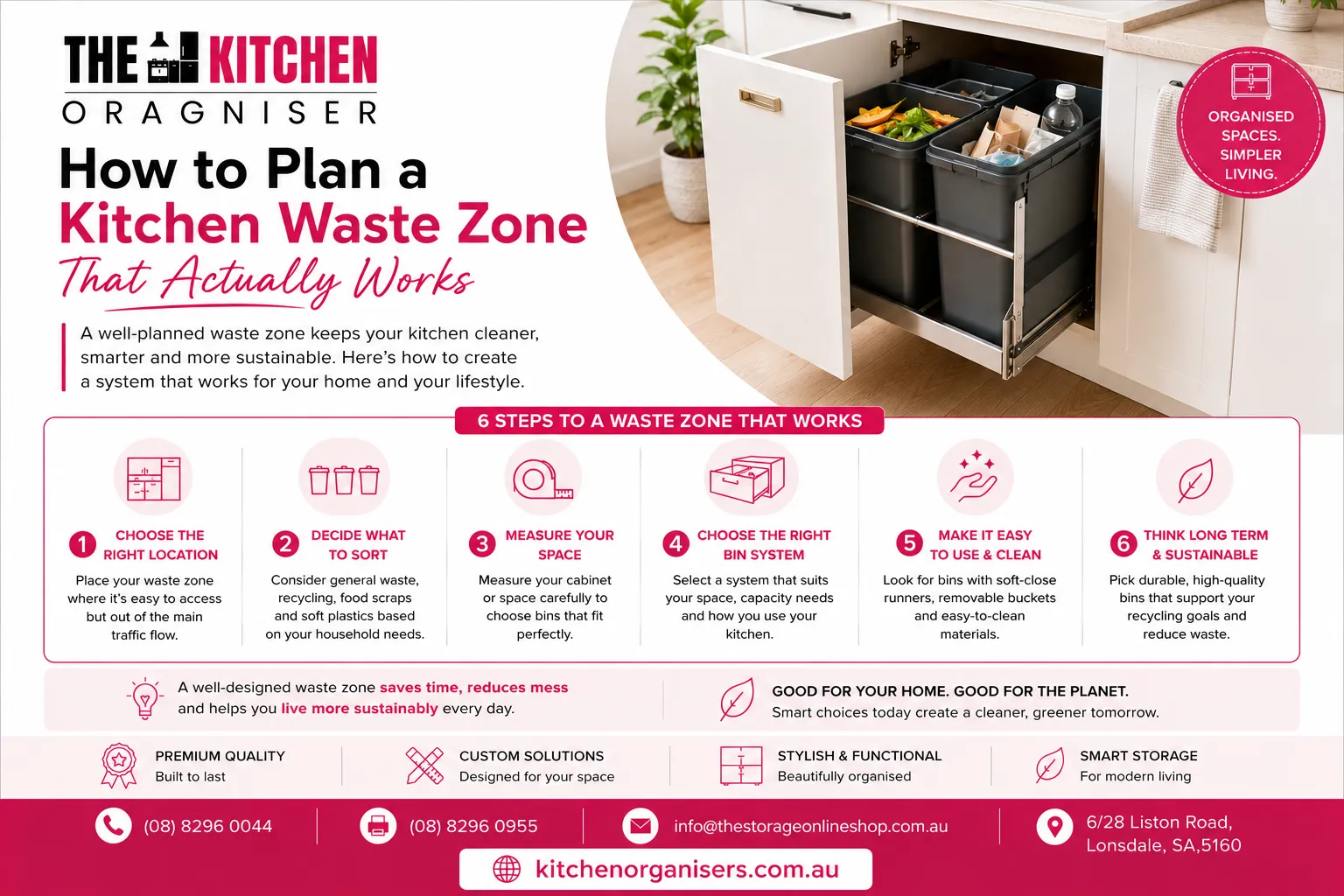
A well-planned waste zone brings the right kitchen bins together in a convenient location. It makes sorting easier, keeps rubbish out of sight and reduces unnecessary movement while cooking and cleaning.
What Is a Kitchen Waste Zone?
A kitchen waste zone is a dedicated area for collecting, separating and removing household waste. It may include containers for general rubbish, mixed recycling, food scraps, bottles, reusable shopping bags, and bin liners.
The zone doesn’t need to occupy a large area. In many homes, it can be created inside one lower cabinet using a pull-out or under-sink system.
What matters is that each container has a clear purpose and sits where the household naturally produces waste.
Where Should Kitchen Bins Be Located?
Close to the main food-preparation or clean-up area, without blocking a walkway.
For many households, the best location is between the sink, preparation bench and dishwasher. This creates a convenient path for disposing of scraps, clearing plates and separating packaging.
A practical position lets you:
-
Sweep scraps from the preparation area without crossing the kitchen.
-
Clear plates before loading the dishwasher.
-
Separate recycling as packaging is opened.
-
Remove a full liner without moving furniture or appliances.
-
Clean the cabinet and surrounding floor easily.
Avoid placing the main bin in a distant pantry simply because a cabinet happens to be empty. A poorly positioned bin means rubbish collects on the benchtop during meal preparation.
Start With Your Household’s Waste Habits
Before buying kitchen rubbish bins, observe what your household throws away during a normal week.
Notice which container fills first. One household produces a large amount of recyclable packaging; another needs more room for general rubbish. Homeowners cooking with fresh ingredients need a convenient food-scrap container.
Ask:
-
How many people live in the home?
-
How often do you cook?
-
Which waste category fills fastest?
-
How frequently are indoor bins emptied?
-
Do children need to use the system?
-
Is there a convenient route to the outdoor bins?
The answers point to the right capacities and compartments.
A family doesn’t automatically need the largest available system. A smaller bin emptied regularly is often cleaner and easier to manage than an oversized container holding waste indoors for days.
One Large Bin or Multiple Compartments?
Choose one large bin when most household waste goes into a single stream. Choose multiple compartments when rubbish, recycling and food scraps need separating at the point of disposal.
A single-bin system suits small households, homes with recycling stored elsewhere, and kitchens with limited cabinet space.
A twin-bin system suits homes separating general waste and recycling, medium-sized cabinets, and kitchens with no room for multiple freestanding bins.
A three-compartment system suits households separating rubbish, recycling and scraps, larger cabinets, and homeowners wanting a complete hidden waste station.
Don’t focus only on total capacity — check the size of each compartment. A 60-litre system divided into three containers may not give enough room for the category your household produces most. The ratio between compartments often matters more than the total litres.
Is an Under Sink Bin a Good Idea?
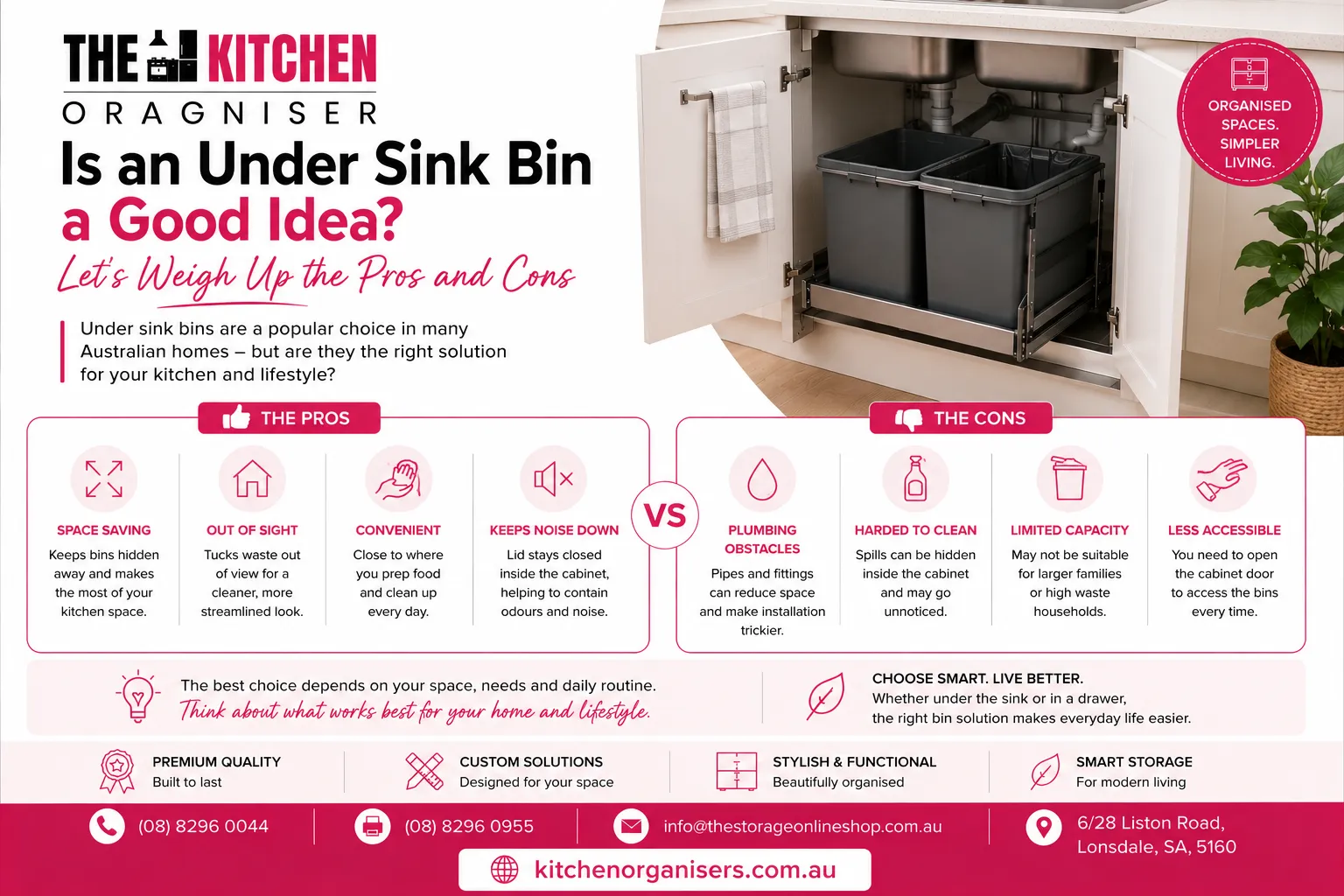
An under sink bin works well when the cabinet has sufficient clearance and you want to use otherwise awkward space. It keeps waste hidden, preserves floor space and usually sits close to food preparation and cleaning.
However, the area beneath a sink contains plumbing, and not every cabinet offers the same usable room. Sink bowls, pipes, water filters, disposal units and hinges all affect available space.
An under-sink system works best when the plumbing leaves enough width and depth, the bin slides out without hitting pipes, the lid has room to open, buckets lift out easily, and the cabinet is dry and free from leaks.
Don’t install a bin so tightly around the plumbing that maintenance becomes difficult.
How to Measure for an Under-Sink System
Measure the usable internal space, not the outside of the cabinet.
1. Empty the cupboard. Remove everything so you can see every obstruction.
2. Measure the cabinet opening. Measure between hinges, door frames and mounting hardware — the opening is often narrower than the interior.
3. Measure the internal width. Check at the front, middle and back. Pipes may reduce the usable space.
4. Measure the depth. From the opening to the rear wall, allowing room for plumbing and hoses.
5. Measure the height. Check clearance beneath the sink bowl. Some bins need extra space for lids or handles.
6. Check the removal path. A bin may fit beneath the sink but become difficult to empty if the bowl blocks its upward movement.
7. Allow a small margin. Don’t select a product matching every measurement exactly.
Pull-Out, Door-Mounted or Freestanding?
Pull-out systems
These sit on runners inside a lower cabinet, sliding forward when opened. Particularly useful in deep cabinets, because the rear container comes forward instead of being reached from inside the cupboard. Check how the runners attach and whether the base is strong and level.
Door-mounted systems
The cabinet door connects to the bin frame, so opening the door brings the containers forward. Disposal feels natural because door and bin move together — but accurate installation matters, and the door must support the system.
Freestanding bins
No installation, easy to move for cleaning. Suits renters, larger kitchens, or households needing more capacity than a cabinet allows. The trade-off is floor space and visibility.
What Makes a Kitchen Bin Easy to Use?
The best systems make everyday disposal, emptying and cleaning straightforward:
-
Removable buckets — easier to lift, empty and wash than a fixed container.
-
Strong handles — help when carrying a full bucket outside.
-
Smooth runners — should open fully without sticking or twisting.
-
Accessible compartments — each container reachable without removing another.
-
Simple surfaces — smooth sides and rounded corners wipe clean easily.
-
Suitable liner fit — a loose liner falls into the bucket when rubbish is added.
-
Stable construction — steady when full, or when one bucket is removed.
Making Recycling Easier
Recycling becomes easier when the correct container is as convenient as the general-rubbish bin. When recycling lives in another room, household members put recyclable packaging into general waste simply because the right container is inconvenient.
Put rubbish and recycling compartments beside each other. Use clearly different containers or labels. Place the larger compartment where the greatest volume is produced. Keep the system simple enough for guests and children to understand, and check your local council’s current instructions.
Avoid too many categories inside a small kitchen. Additional streams can live in a laundry or garage when they don’t need daily access.
Common Planning Mistakes
Buying before measuring. A product may state a minimum cabinet width, but pipes, hinges, depth and height still matter.
Choosing equal compartments automatically. Your household may produce twice as much recycling as general waste.
Positioning the bin too far away. An inconvenient location creates extra movement and temporary rubbish piles on the bench.
Ignoring the cabinet opening. The cupboard may be wide enough while the door frame stops the system sliding through.
Blocking plumbing access. Pipes, taps and filters must stay reachable for maintenance.
Overcomplicating waste separation. A successful system is one the whole household understands. Start with essential categories and expand only when needed.
Frequently Asked Questions
What is an under sink bin?
A waste container designed to fit inside the cabinet beneath a kitchen sink. It may be freestanding, mounted to the door or installed on pull-out runners.
Can an under sink bin fit around plumbing?
Some systems can, but the available room depends on the position of the sink bowl, pipes and filters. Measure the complete usable space before purchasing.
Are pull-out kitchen rubbish bins worth it?
Worthwhile when easy access, hidden storage and waste separation are priorities. Their value depends on correct measurements and suitable cabinet construction.
What size kitchen bin should a family choose?
It depends on how much waste the family produces and how often it’s emptied. Compare the capacity of each compartment rather than choosing by total litres.
Can renters install a pull-out bin?
Permanent systems may require drilling. Renters should obtain approval or choose a freestanding, removable alternative.
Final Thoughts
A practical waste zone is one of the least visible but most valuable parts of an organised kitchen.
The right setup makes it easier to dispose of scraps while cooking, separate recycling correctly, keep rubbish out of sight and remove full containers without mess.
Begin with household behaviour rather than product size. Decide which waste streams need collecting, identify the most convenient location and measure the usable space carefully.
Whether you choose a freestanding bin, a pull-out cabinet system or a compact under-sink option, the best solution is the one that feels simple to use every day.